
Review · ROME
Pantheon Elite Guided Tour – Rome’s Iconic Ancient Temple
The Pantheon’s great surprise is that it feels both ancient and alive. You look up through the open oculus, watch daylight move across the dome, and stand inside a building that has served pagan and Christian purposes across two thousand years. A guide helps you connect those layers instead of seeing only a grand round church.
I like the one-hour format, which fits neatly between other Roman sights, and I like the timed admission that can make entry quicker than joining the general crowd. Guides such as Elena, Amanda, Silvia, Nina, and Samantha are praised for clear explanations and lively delivery. The drawback is the crowd around the entrance, especially on Sundays and busy dates, plus the fact that the group can reach 20 people.
Key points to know before booking
- The oculus is open to the sky: Your guide explains its engineering, light, airflow, and the old story linking it to Romulus.
- You see pagan and Christian Rome together: The building began as a temple and now functions as a basilica.
- The visit lasts about one hour: It covers the interior and exterior without taking over your day.
- Timed entry helps with access: This is not a magic way to erase every queue, but pre-booked named tickets can speed the process.
- Headsets help inside the crowd: Audio equipment lets you hear the guide, though a replacement headset may be needed if the sound is unclear.
- Dress modestly: Knees and shoulders must be covered to enter.
Why the Pantheon deserves a guided hour
You can walk into the Pantheon, look around, take a few photographs, and leave in ten minutes. I would not recommend that for a first visit. The building is visually simple at first glance, but its meaning changes as you learn what you are seeing.
The enormous dome is the obvious star. The open circle at its center, the oculus, lets in light and weather. That opening is not a flaw or a missing window. It is the main source of light and part of the building’s design. Your guide points out the way the dome, circular interior, and massive entrance work together.
The Pantheon also rewards historical context. It began as a sacred temple connected with the Campus Martius, the Field of Mars, outside Rome’s early city walls. The present structure belongs to the age of Augustus, though the building has been altered and rebuilt over time. Its continued survival is closely tied to its conversion into a Christian church.
That combination is what makes the visit different from a stop at a standard ancient ruin. Here you are not looking only at foundations or broken columns. You are inside a functioning religious building where Roman engineering, Christian worship, royal burials, art, and legend occupy the same space.
More Temple Tours around Italy:
- Agrigento: Valley of the Temples Skip-the-Line Sunset Tour
★ 4.5 · 1,512 reviews - Palermo: Agrigento and the Valley of the Temples Day Tour
★ 4.2 · 1,240 reviews - Rome’s Iconic Temple: Pantheon Audio Guided Tour with Fast Access
★ 4.0 · 1,188 reviews
Meeting at Piazza della Rotonda
The tour begins at Antica Salumeria, Piazza della Rotonda 4. The meeting point is beside one of Rome’s most memorable public squares, so give yourself time to identify the exact location rather than arriving at the last second.
The Pantheon area can be crowded, and the square may be difficult to navigate at peak times. Sunday is often especially busy. If you arrive by car, allow extra time, since one person had to repeat the tour after arriving 20 minutes late because of parking trouble. The practical lesson is simple: use public transportation when possible and do not cut the timing close.
The activity is near public transportation, and the tour ends back at the meeting point. That makes it easy to continue on foot through central Rome after the visit, though this tour itself does not include additional stops.
Inside the Pantheon: 40 minutes of history and detail
The main portion of the experience lasts about 40 minutes inside the Pantheon. This is where the guide’s skill matters most. A good guide turns a circular room into a sequence of questions: Why is the dome shaped this way? How does the oculus affect the interior? Why did the building survive when so many ancient structures disappeared?
Guides including Amanda, Elena, Silvia, Nina, Samantha, Donatella, and Viviana have been singled out for clear, engaging presentations. Amanda’s background in archaeology and Roman history is useful for visitors who want more than dates. Elena is praised for connecting the Pantheon to the wider story of Rome in a short time. Samantha is noted for keeping the visit enjoyable even in rainy weather.
You can expect explanations of the building’s construction, its changing purpose, and details that are easy to miss on your own. One guide has pointed out airflow and water drainage, two practical features hidden behind the grand appearance. Rain can enter through the oculus, so the floor’s drainage system matters. That small detail makes the Pantheon feel like a piece of working engineering rather than a frozen monument.
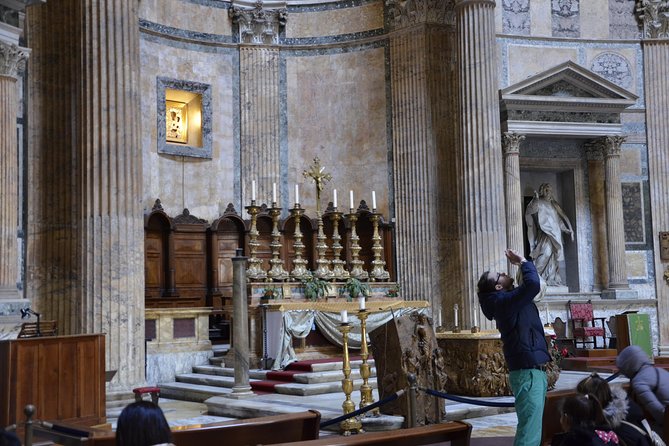
The guide also explains the meeting of pagan and Christian traditions. The original temple was tied to Roman religion and imperial power. Later, the structure became a basilica, which helped preserve it and gave the interior its Christian character. Paintings, sculptures, chapels, and tombs now share space with the ancient form.
The royal tombs add another layer. Italy’s King Victor Emmanuel II and King Umberto I are buried here, along with Queen Margherita. Raphael, one of the most famous artists of the Renaissance, is also buried inside. Your guide helps you understand why this building became important not only as an ancient monument but also as a place of national memory and artistic honor.
The dome and oculus: the tour’s best visual moment
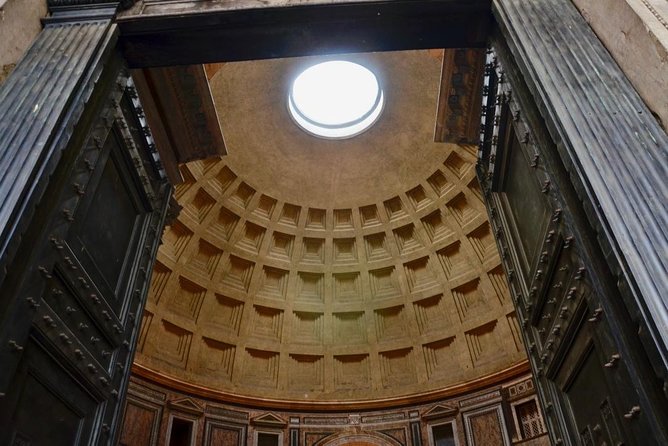
The oculus is the detail you will remember most clearly. It is an opening directly to the sky, and the light from it changes the room throughout the day. The guide points out how this opening affects the interior and discusses the old story that Romulus was struck by lightning at this spot.
That legend belongs to Rome’s larger foundation mythology, where Romulus is credited with creating the city. The tour connects the Pantheon to those early stories without treating them as proven history. This is helpful because Roman sites often mix archaeology, religion, political symbolism, and legend.
Look up as soon as you enter, but also look down. The floor and the way water is managed are part of the building’s practical design. The guide’s comments about air movement and drainage give you something to notice beyond the familiar dome photograph.
The scale can be hard to judge in a busy room. A headset helps you hear the guide while standing apart from the group, and the audio system has been replaced after earlier sound problems. Still, listen for the first few minutes and tell the guide if you cannot hear clearly. Spare equipment is available according to the tour information, and it is better to solve the problem immediately than miss the main explanation.
Same sacred ground, another way to see it:
- Agrigento: Valley of the Temples Ticket & App Audioguide
★ 4.3 · 1,160 reviews - Colosseum Special Access Tour, with Ancient Temples & Tombs
★ 4.8 · 747 reviews - Agrigento: Valley of the Temples E-Scooter Tour
★ 4.6 · 557 reviews - Palermo: Valley of the Temples and Scala dei Turchi Day Trip
★ 4.1 · 463 reviews
The exterior: 15 minutes with the columns
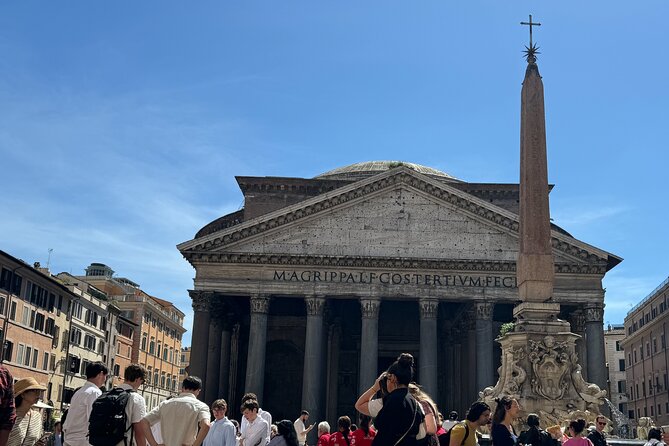
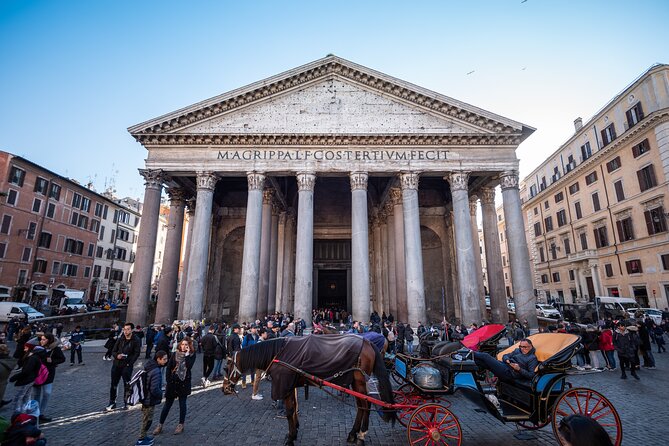
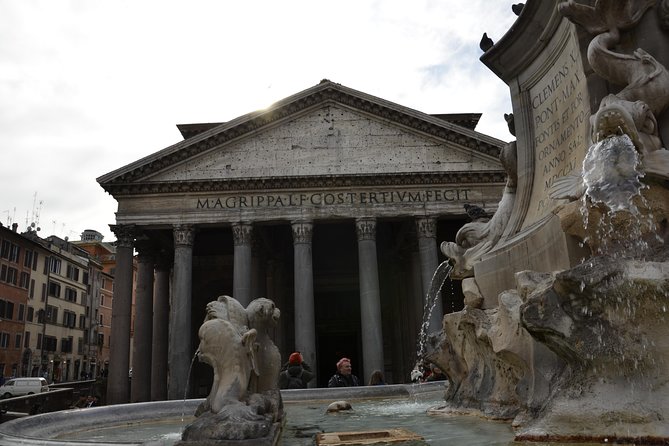
The short exterior portion lasts about 15 minutes. From the square, the guide explains the massive columns, the triangular entrance, the circular temple plan, and the visible layers of the building’s past.
The outside can look almost separate from the inside. The rectangular portico gives the Pantheon a traditional temple front, while the rotunda behind it creates the vast round interior. That contrast is one of the building’s cleverest features, and the guide helps you understand how the parts fit together.
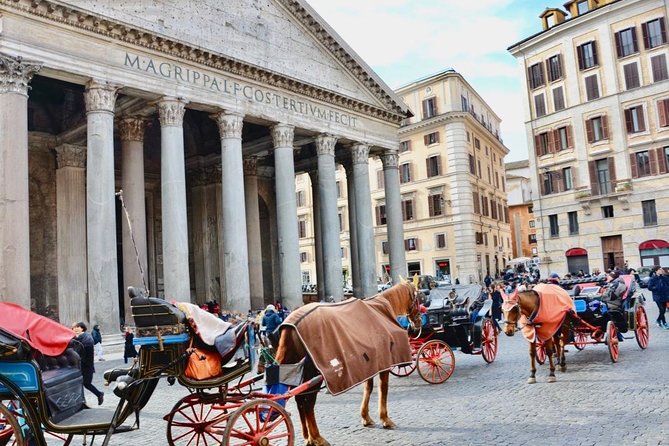
The exterior stop also gives you a better view of the monument’s setting. The Pantheon is not isolated in a quiet archaeological park. It is surrounded by the everyday life of central Rome, with people crossing the square and gathering near the entrance. That energy is part of the experience, but it can also make the first few minutes hectic.
If you want a calm, nearly empty setting, this is not the right expectation. A private tour or a less crowded departure might offer more breathing room, but this activity is a shared group tour with a maximum of 20 people.
Timed entry and the reality of the queue
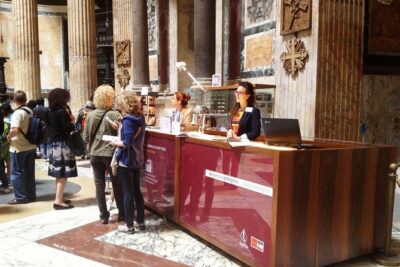
The tour uses pre-booked, individually named tickets for specific time slots, except on the first Sunday of each month when museum access is free. This system can help your group enter promptly, but it should not be confused with a guaranteed way to walk past every person outside.
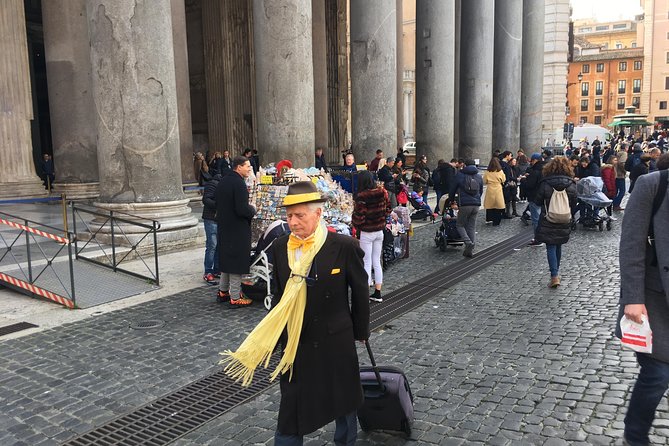
The entrance area can be crowded, especially on Sundays and at the end of the year. Some groups move inside quickly, while others may face a slower process because of the number of people at the monument. The advantage is better planning, not complete control over the crowd.
I like the timed system because it protects a compact itinerary. If you have a reservation for a museum, cooking class, or another Rome attraction later in the day, a scheduled Pantheon visit is easier to fit in than an open-ended wait. You still need to arrive on time. Late arrival can mean missing the group and needing to repeat the tour.
Is $41.08 a fair price?
At $41.08 per person, this is not the cheapest way to enter the Pantheon. The value comes from the explanation, the reserved timed access, and the chance to ask questions during a compact visit.
If you already know Roman architecture and have read about the Pantheon, you may feel satisfied exploring alone. The building is free to admire from the square, but the paid experience adds structure and interpretation. For a first visit, I think the price is easier to justify because the Pantheon contains details that are not obvious from a quick look.
The one-hour length also helps the value. You are not paying for a half-day program when you only want one monument. You get a focused introduction, then remain free to spend the rest of your day at nearby churches, piazzas, museums, or cafés.
A group of up to 20 is small enough for a guide to manage but not intimate. You may have room to ask questions, yet you should not expect the quiet pace of a private tour. If personal attention is your top priority, this format may feel too large.
Who will get the most from this tour?
I would choose this tour for a first-time visitor who wants the Pantheon explained without spending several hours on ancient Roman history. It suits people interested in engineering, religion, art, and the way Rome keeps reusing old buildings.
It also works well for families and mixed-interest groups. The guide’s stories about Romulus, the oculus, royal burials, and Raphael give different age groups something to follow. The short duration helps if your group has limited patience for long museum visits.
The tour can also suit people with mobility concerns, since the Pantheon is described as accessible for people with disabilities. The supplied information says most people can participate, though you should assess your own needs and contact the provider if you require specific assistance.
I would hesitate if you dislike shared headsets, crowded public spaces, or fixed schedules. A few people have had trouble with audio clarity, even though the equipment has since been upgraded. Tell the guide at once if the sound fails, rather than trying to follow from a distance.
Practical details that can make the visit better
Cover your knees and shoulders before you arrive. The Pantheon is a church, and entry requires modest dress. This is easy to overlook during a hot Roman afternoon, so carry a light layer or scarf if needed.
Check the weather before leaving. The activity requires good weather, and a cancellation caused by poor conditions may result in another date or a full refund. That policy is unusual for an indoor monument, but it is part of the stated booking terms.
You can cancel for a full refund up to 24 hours before the start time. Changes or cancellations inside that window are not accepted and are not refunded. The local time in Rome controls the deadline.
The tour is offered in English, with several morning and afternoon departure times. It is often booked well ahead, with an average booking lead time of 48 days. If your Rome dates are fixed, reserve early rather than treating this as a last-minute add-on.
Should you book the Pantheon Elite Guided Tour?
Book it if you want the Pantheon to make sense, not just look impressive. The oculus, dome, Roman temple plan, church interior, royal tombs, and Raphael’s burial place all become more meaningful when someone explains how they fit together.
I would especially recommend it for a first visit, a tight schedule, or anyone curious about ancient engineering and Roman religion. The strongest part is the guide-led interpretation, with names such as Elena, Amanda, Silvia, and Samantha receiving praise for clear, warm presentations.
Skip it if you prefer to move alone, dislike group audio, or already have strong knowledge of the Pantheon. The entrance square can be crowded, the group may reach 20 people, and timed admission does not remove every delay. For most first-time visitors, though, an hour and $41.08 buys a useful layer of understanding at one of Rome’s most unusual buildings.
FAQ
How long does the Pantheon tour last?
The tour lasts approximately one hour. About 40 minutes are spent inside the Pantheon, followed by about 15 minutes focused on the exterior.
What language is the tour offered in?
The tour is offered in English.
Where does the tour begin?
It begins at Antica Salumeria, Piazza della Rotonda 4, 00186 Rome.
Where does the tour end?
The activity ends back at the meeting point.
How much does the tour cost?
The listed price is $41.08 per person.
How many people can join the group?
The maximum group size is 20 people.
Do I need to cover my knees and shoulders?
Yes. Knees and shoulders must be covered when entering the Pantheon.
Is the Pantheon near public transportation?
Yes. The meeting point is near public transportation.
Can I cancel for a refund?
Yes. You can cancel up to 24 hours before the start time for a full refund. Cancellations made less than 24 hours before the experience are not refunded.
What happens if bad weather cancels the tour?
You will be offered a different date or a full refund if the activity is canceled because of poor weather.
Temple visits we reviewed lately in Italy
- Rome: Temples, Squares & Markets Guided Walking Tour★ 4.8 · 26 reviews
- Rome underground hidden temples, ruins, and secret basilicas★ 3.7 · 21 reviews
- Rome: Tour of St. Clement’s Basilica Underground Temples★ 4.8 · 242 reviews
- Palermo to Siracusa: stop al Valley of Temples & Roman Villa★ 5.0 · 5 reviews
- Paestum Tour: Best Preserved Temples in the World (UNESCO)★ 4.5 · 11 reviews
- Paestum: 2-Hour Greek Temples & Archaeological Museum★ 4.8 · 19 reviews
- Paestum: Temples and Museum Tour with Archaeologist Guide★ 5.0 · 14 reviews
- Neustift Monastery: Admission with audio guide★ 4.6 · 9 reviews
Rome Temple Tours, compared.
Rome’s Iconic Temple: Pantheon Audio Guided Tour with Fast Access
Read our review →
Colosseum Special Access Tour, with Ancient Temples & Tombs
Read our review →
Walking Guided Tour and Rome’s Iconic Temple Pantheon Entrance
Read our review →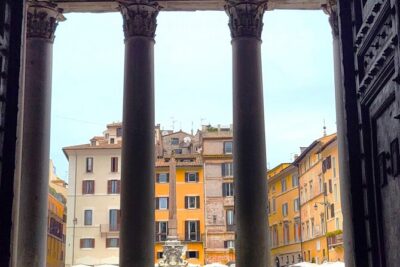
Rome’s Iconic Ancient Temple: Pantheon Fast Track Entry Tickets
Read our review →
Rome: Tour of St. Clement’s Basilica Underground Temples
Read our review →
Pantheon: The Iconic Ancient Roman Temple – Semi-Private Tour
Read our review →
Rome: Temples, Squares & Markets Guided Walking Tour
Read our review →
Rome underground hidden temples, ruins, and secret basilicas
Read our review →This tour also ranks in