
Review · SIEM REAP
Siem Reap: Bike the Angkor Temples – Full-Day 30km Tour
Angkor is far too large to understand from a single temple courtyard. This 30km bicycle route connects Angkor Wat, Bayon, Ta Prohm, forest paths, village roads, and rural scenery in one full day. You get the famous monuments, but you also see the quiet spaces between them.
I like the small maximum group of 10, which keeps the ride personal and makes it easier to ask questions. I also like the care built into the day: well-maintained mountain bikes, helmets, cold water, fruit, snacks, a local lunch option, and guides such as Chen, Moon, Wich, and Mun who explain both temple history and modern Cambodia.
The catch is simple: this is an active outing in a hot climate. The roads are mostly flat, but sandy and bumpy sections can make the final kilometres tiring. If you are not comfortable cycling for several hours, a tuk-tuk-based temple tour will be easier.
Key points to know before booking
- About 25 to 30km of cycling: Most roads are flat, but some forest trails are sandy, uneven, or less suitable for beginners.
- Three major temple stops: You visit Angkor Wat, Bayon, and Ta Prohm, with time for the Terrace of the Elephants, Terrace of the Leper King, and Royal Enclosure.
- A quieter route through Angkor: Forest tracks, village roads, and local communities give you more than the standard temple circuit.
- Practical support throughout the day: Bikes, helmets, bottled water, fruit, snacks, and an optional Khmer lunch are included.
- Small-group feel: The group limit is 10, and a second guide or support rider may help with safety and pacing.
- Budget for the park pass: The one-day Angkor Pass costs an additional $37, so the real basic cost is $72 before any lunch upgrade.
Why a bicycle works so well at Angkor
Angkor Archaeological Park covers a huge area, roughly half the size of New York City. A bicycle gives you a useful middle ground. You cover enough ground to see the main monuments, yet you move slowly enough to notice palm trees, forest paths, roadside homes, and the changing sound of the park.
A vehicle gets you between temples quickly, but it also keeps you inside a small travel bubble. On this ride, the journey matters almost as much as the stops. You pass through wooded sections and small villages, then arrive at a temple gate under your own power. That change of pace helps Angkor feel like a living area, not just a string of monuments.
I would not call this a hard mountain-bike ride, but it is not a casual spin around town, either. You should be comfortable riding for several hours and managing an uneven surface. Reviews describe well-kept bikes with suspension suited to the rougher tracks, but even good equipment cannot remove the heat, sand, or effort.
The 7:30am start is useful. Morning light is attractive at Angkor Wat, and an early departure gives you cooler riding conditions before the day becomes intensely warm. The tour lasts about eight and a half hours, so plan to give it most of your day.
More Angkor Wat Tours in Siem Reap:
- Angkor Wat Sunrise or Sunset Tour with Guide from Siem Reap
★ 5.0 · 12,109 reviews - Siem Reap: Angkor Wat: Small-Group Sunrise or Sunset Tour
★ 5.0 · 9,444 reviews - Siem Reap: Angkor Wat 2-Day Tour with Sunrise and Sunset
★ 4.9 · 4,429 reviews
Starting in Siem Reap with the right bike
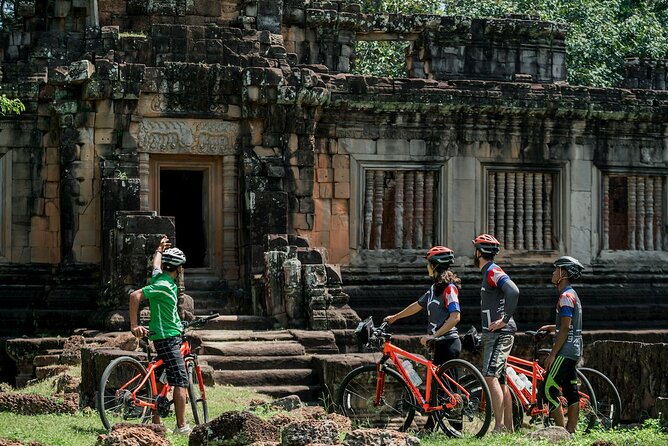
You make your own way to ផ្ទះគ្រូ Café, the meeting point in Siem Reap. After introductions, the guide gives a safety briefing and helps fit you with a mountain bike and helmet. Bikes may be labelled with your name and adjusted to your height, a small detail that makes a long ride more comfortable.
The route begins toward the park entrance. Your guide assists with buying the Angkor Pass, but the pass is not included in the tour price. The one-day ticket costs $37, compared with the advertised tour price of $35 per person. That means you should think of the outing as a roughly $72 experience before adding lunch, drinks, or other personal spending.
The safety arrangements are one of the stronger parts of the operation. Guides explain riding signals and keep the pace suited to the group. On some outings, a guide rides at the front and another stays behind. That matters when the route includes public roads, sandy tracks, and riders with different levels of confidence.
You will need clothing that works for both cycling and temple entry. Sleeveless or see-through tops are not permitted, and shorts or trousers must reach at least the knee. Wear practical cycling clothes that cover you properly, plus sunscreen, a hat for stops, and shoes suitable for dirt tracks.
Angkor Wat: begin with the essential monument
Angkor Wat is the natural first major stop. Its towers, galleries, carved walls, and long approach make it one of the world’s great temple complexes, but its size can be hard to grasp if you simply arrive, take photographs, and leave.
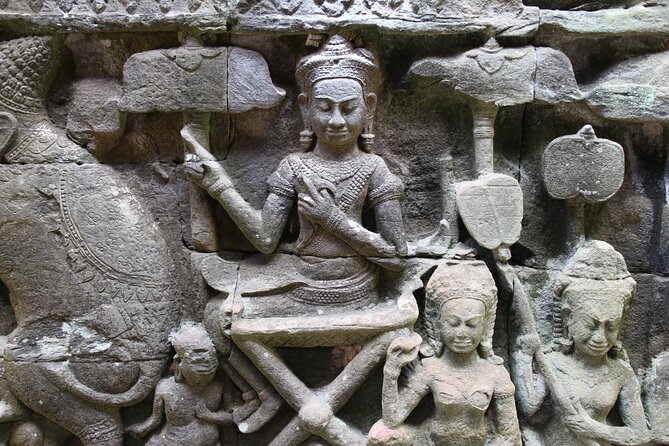
The guide gives the buildings a useful frame. You learn how the carvings relate to Hindu stories, including scenes from the Ramayana, and how the temple was designed as a sacred centre. Allow about an hour here, though the actual time can vary with the group and the pace of temple exploration.
The bicycle arrival adds a pleasing sense of scale. You have already ridden through the park before reaching the monument, so Angkor Wat appears as part of a much larger setting rather than an isolated attraction. The tradeoff is that the temple visit comes after an early start and some initial riding, so use the water provided and do not rush the first stop.
Angkor Wat has many stairs, galleries, and long walking sections. Your bicycle stays outside while you explore on foot. This is also the point where proper temple clothing matters most, since entry rules are enforced.
Angkor Thom and Bayon’s stone faces
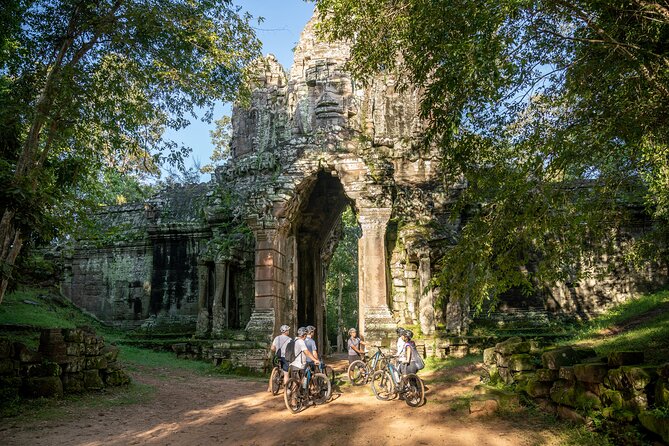
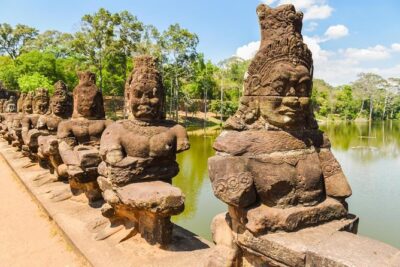
From Angkor Wat, the route continues toward Angkor Thom along the main road. The approach is memorable in its own right, with monumental gates and rows of stone figures representing divinities and demons. Cycling through these entrances gives you a better feel for the scale of the old city than arriving by vehicle.
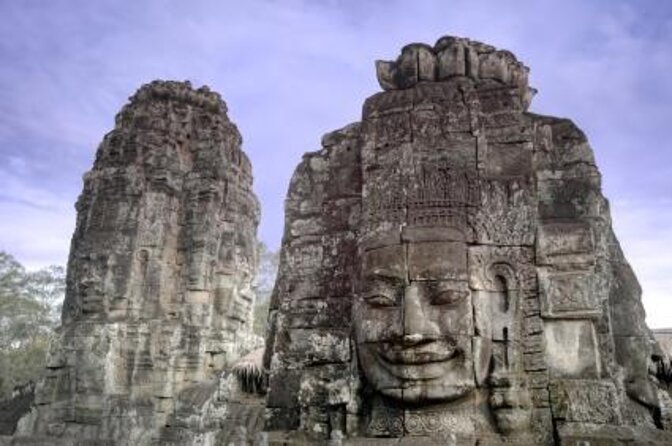
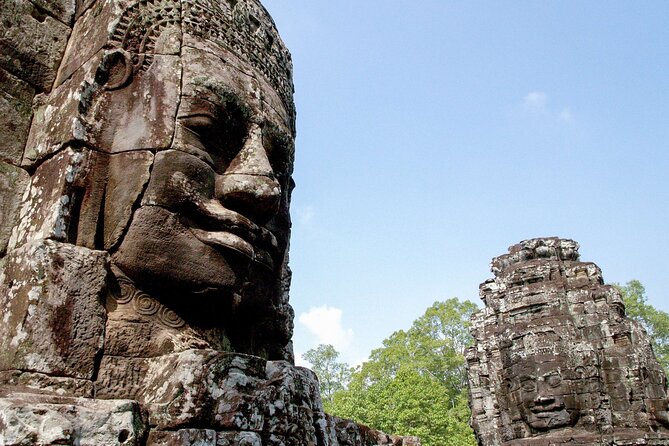
Bayon is the dramatic centrepiece of Angkor Thom. Its towers carry serene stone faces that appear from different angles as you move through the cramped galleries. The temple can feel confusing at first, with corridors, stairs, and faces appearing above you. A guide helps you make sense of the plan and points out details you could easily miss.
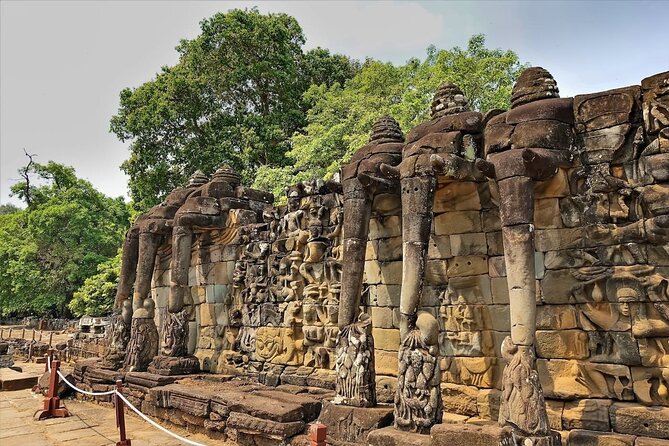
The surrounding stops broaden the picture. You may visit the Terrace of the Leper King, the Terrace of the Elephants, and the Royal Enclosure. These remains are less complete than Bayon, but they help explain how the royal city functioned. The Elephant Terrace, in particular, shows the ceremonial scale of Angkor Thom.
This section combines road cycling with substantial walking. I like that balance because you are not simply pedalling from photo stop to photo stop. Still, keep some energy in reserve. The day is only partly over, and the afternoon ride can be the hardest part in hot weather.
More Cycling Tours in Siem Reap:
- From Siem Reap: Angkor Wat Sunrise and Temples E-Bike Tour
★ 5.0 · 52 reviews - Angkor Wat: Guided Sunrise Bike Tour w/ Breakfast and Lunch
★ 4.8 · 48 reviews - Angkor Wat Bike Tour with Lunch Included
★ 4.8 · 9 reviews - Angkor Wat Sunrise Bike Tour With Lunch Included
★ 5.0 · 7 reviews
Srah Srang and a proper Khmer lunch break
The Srah Srang area provides a natural pause in the middle of the day. The reservoir and surrounding trees offer a change from enclosed temple corridors, while lunch gives you time to sit down, cool off, and refuel.
If you select the lunch option, a local meal is arranged in advance. The food is described as generous and tasty, with fresh fruit and snacks available during the day. Some outings allow you to choose from a menu, and drinks or beer may cost extra. If you have dietary needs, state them when booking rather than waiting until lunch.
This break is not just about food. Thirty kilometres on a bicycle in Cambodian heat requires regular fuel, and the fruit stop can arrive at exactly the right time. Cold bottled water is supplied throughout the ride, and the return to the Siem Reap office may include a chilled coconut drink and cold towel.
If you choose the tour without lunch, you should confirm how the meal stop works and budget for your own food. The supplied details clearly make lunch an option rather than a universal inclusion. Either way, do not treat the refreshments as a reason to skip your own water or sunscreen routine.
Ta Prohm and the afternoon forest ride
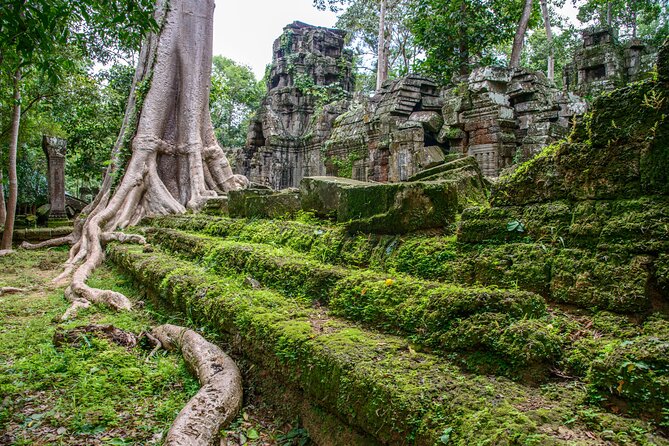
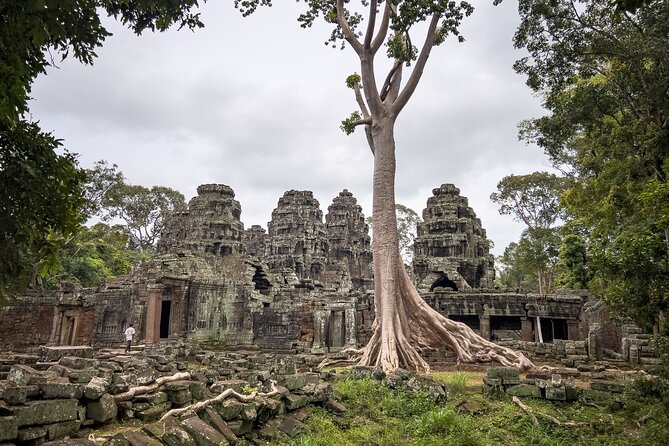
Ta Prohm is the afternoon highlight for many people. Tree roots wind over walls and doorways, while moss and shade soften the stone. It has a different mood from Angkor Wat’s open galleries and Bayon’s crowded towers.
The bicycle route makes the arrival feel appropriate. You ride through quieter forest corridors before reaching the temple, so the setting gradually changes from open road to jungle shade. At Ta Prohm, the guide explains the temple’s history, stories, and symbolism, then gives you time to walk among the ruins and take photographs.
This stop also exposes one of the day’s practical limits. Ta Prohm can be crowded, and the paths around the ruins are uneven. Your bike ride does not guarantee solitude at the monument itself. Its real advantage is the approach, plus the chance to experience the wider park between the headline sites.
The route description includes lesser-known ruins and off-road sections, although the exact minor stops can depend on conditions and the group. That flexibility is useful. A guide can choose a safer or more comfortable track when sand, weather, or traffic makes a planned section unpleasant.
Villages, dirt tracks, and the part you cannot get by car
The most distinctive stretch comes between the temples. You ride through forest, small roads, village areas, and countryside rather than staying on the main tourist circuit. You might see homes, farms, rice fields, and ordinary daily activity close to the park.
This is where the tour earns its active format. The temples are the reason you come to Siem Reap, but the village ride gives you a better sense of the area around them. You see how much open space surrounds the monuments and how modern life continues beside the ancient sites.
The surfaces are mixed. Some sections are asphalt, while others are sandy, bumpy, or rough. One rider described the route as safe and well managed, with hand signals and a pace aimed at control rather than speed. That is the right expectation: this is not a race, and the support staff are there to keep the group together.
You may feel some knee or leg fatigue by the end, especially if you are unused to riding on sand. I would avoid new trousers or delicate clothing, since a forest trail can be hard on fabric. Bring a small amount of flexibility into your plans after the tour rather than booking another demanding activity immediately afterward.
Guides, group size, and the human side of the ride
Guide quality matters greatly on a tour like this. The strongest feedback centres on guides including Chen, Moon, Wich, Mun, Meun, Pat, Samnang Chan, Samie, Sam, Sunchen, and We. Their role is more than leading the route. They explain temple details, answer questions, discuss Cambodian culture, and watch the group’s safety.
Chen is praised for turning the ride into a personal exploration, while Moon is noted for careful attention to lunch and refreshments. Wich and Mun are described as helpful and informative, and Pat is credited with steering the group around busy areas and choosing useful routes. Names may vary by departure, but the pattern is clear: the guide is a major part of the experience.
The maximum group size is 10. That is small enough for questions and personal pacing, though a group tour still means waiting at temple entrances, regrouping after road sections, and accommodating different fitness levels. Private touring is available as an upgrade if you want more control over stops and attention.
Families can take part, and a child seat is available on request for a child weighing up to 14kg. Most participants can manage the outing, but the distance and heat make moderate fitness important. Children and adults alike need to be ready for both cycling and walking.
What the $35 price really gives you
At $35 per person, the tour is reasonably priced for a full day with a bike, helmet, English-speaking cycling guide, water, fruit, snacks, and the option of lunch. You are also paying for route planning, safety support, bike fitting, and a guide who helps connect the monuments to the wider area.
The apparent bargain becomes less dramatic once you add the $37 Angkor Pass. The park admission is a separate and unavoidable cost for most visitors, so include it in your budget from the start. The lunch option may also change the final price.
Even so, the value is good if you want more than transport between three temples. A standard vehicle tour may reduce physical effort, but this package gives you a full day of guided riding, rural scenery, and access to paths you would not normally see from a car. The value is weaker if you are mainly interested in lengthy temple photography, dislike heat, or want to move quickly between monuments.
Free cancellation is available up to 24 hours before the start time. Changes or cancellations inside that window are not accepted for a refund. The tour ends back at the meeting point, and hotel pickup and drop-off are not included.
What to pack for a comfortable day
Keep your packing simple, but take the heat seriously.
- Knee-covering trousers or shorts and a top that covers your shoulders
- Sunscreen, sunglasses, and a hat
- Comfortable shoes for both cycling and temple stairs
- Extra personal water, even though bottled water is supplied
- A small amount of cash for the park pass, drinks, or souvenirs
- Clothing that can handle dust, sand, and rough tracks
- Any dietary information, supplied when booking
The tour includes a helmet, but you may prefer to bring your own if you have one that fits especially well. A phone or camera is useful, though protect it from dust on the forest sections.
Who should book this Angkor cycling tour?
I would choose this tour if you want the major Angkor temples with a strong dose of countryside and exercise. It suits first-time visitors who want orientation, active couples or friends, families with older children, and solo visitors who would enjoy company during a long day.
I would be more cautious if you have limited cycling fitness, knee problems, or a strong dislike of hot weather. The roads are mostly flat, but flat does not mean effortless. Sand and heat can turn a gentle ride into a demanding one.
If your priority is sunrise photography, check the departure details carefully. The stated start is 7:30am, and the day focuses on a broad temple circuit rather than a dedicated sunrise outing. If your priority is seeing Angkor through local roads, forest paths, and village life, this format is a strong match.
Should you book it?
Book it if you want to understand the scale of Angkor with your own legs, not just from the back seat of a vehicle. The best parts are the well-maintained bikes, thoughtful support, strong guides, generous refreshments, and the quiet roads connecting the famous temples.
Skip it if you want a relaxed, air-conditioned day or if 25 to 30km sounds excessive. For everyone else, this is one of the more rewarding ways to combine Angkor’s essential monuments with a glimpse of everyday Cambodia. Bring sunscreen, wear sensible clothes, pace yourself, and treat the ride between temples as part of the main experience.
FAQ
How far do you cycle on the tour?
The ride covers approximately 25 to 30km, or about 15 to 18 miles. Most of the route is flat, but some dirt trails are sandy or bumpy and may be difficult for complete beginners.
What temples are included?
The main temple stops are Angkor Wat, Bayon, and Ta Prohm. The route also includes the Terrace of the Leper King, Terrace of the Elephants, and Royal Enclosure, along with countryside and lesser-known areas.
Is lunch included?
Lunch is included only if you select the lunch option. Snacks, fruit, and bottled water are included with the tour. Dietary requirements should be provided when booking.
Is the Angkor Pass included in the price?
No. The one-day Angkor Pass is an additional $37 per person. The guide helps you purchase it at the park entrance.
Where does the tour start and finish?
You meet at ផ្ទះគ្រូ Café in Siem Reap at 7:30am. The tour ends back at the same meeting point. Hotel pickup and drop-off are not included.
What clothing is required for the temples?
Sleeveless and see-through shirts are not permitted. Pants and shorts must reach at least the knee. Choose clothing that also works for cycling and dirt trails.
Is the tour suitable for children?
Most people can participate, but the distance and hot conditions require reasonable cycling ability. A child seat is available on request for a child weighing up to 14kg.
More Full-Day Tours in Siem Reap
- Siem Reap: Full-Day Angkor Wat Guided Tour with Sunset
★ 4.9 · 3,803 reviews - Full-Day Angkor Wat Sunrise Private Tour with Guide from Siem Reap
★ 5.0 · 2,920 reviews - Siem Reap: Angkor Wat Sunrise and Full-Day Sightseeing Tour
★ 4.9 · 2,828 reviews - Full-Day Guided Sunset Tour of Angkor Wat
★ 5.0 · 1,507 reviews
Temple visits we reviewed lately in Siem Reap
- Angkor Wat Tour by Tuk-Tuk with English Speaking Driver★ 4.5 · 65 reviews
- Private Sunrise Angkor Wat Tour★ 4.6 · 16 reviews
- Private One Day Tour with Sunrise at Angkor Wat★ 5.0 · 3 reviews
- Siem Reap Tour Guide: Angkor Wat Sunrise Tour & Beng Mealea★ 5.0 · 4 reviews
- Siem Reap Private Tour: Angkor Wat Sunrise And Banteay Srei★ 5.0 · 3 reviews
- Private Angkor Wat Sunset Tour with Lunch and Snack Included★ 5.0 · 3 reviews
- Private Angkor Wat Sunrise Tours And Sunset Floating Village★ 5.0 · 3 reviews
- Private Angkor Wat Temple Tour★ 5.0 · 35 reviews
Siem Reap Temple Tours, compared.
Angkor Wat Sunrise or Sunset Tour with Guide from Siem Reap
Read our review →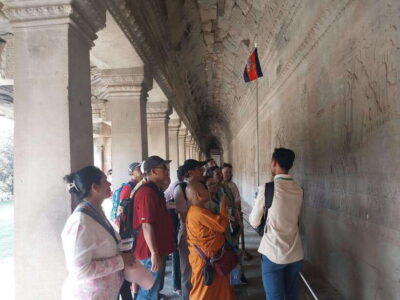
Siem Reap: Angkor Wat: Small-Group Sunrise or Sunset Tour
Read our review →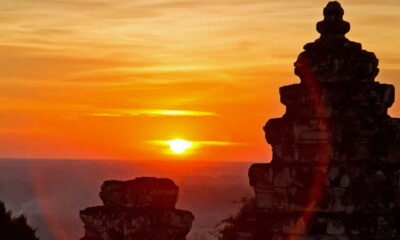
Siem Reap: Full-Day Angkor Wat Guided Tour with Sunset
Read our review →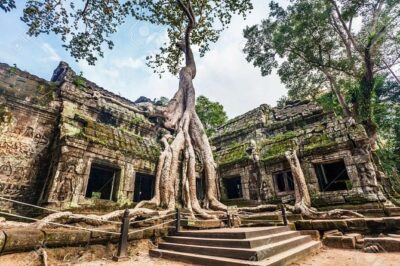
Angkor Wat Sunrise tour with Small – Group and Guide tours
Read our review →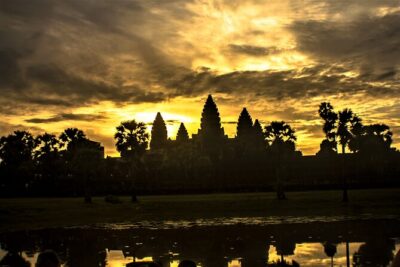
Angkor Wat Highlights and Sunrise Guided Tour from Siem Reap
Read our review →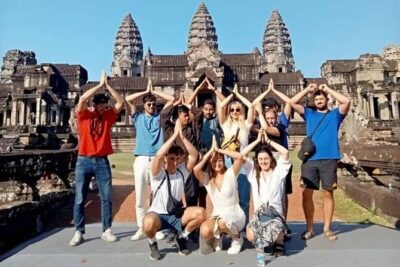
Angkor Wat Sunset Small Group Tour with Lunch Included
Read our review →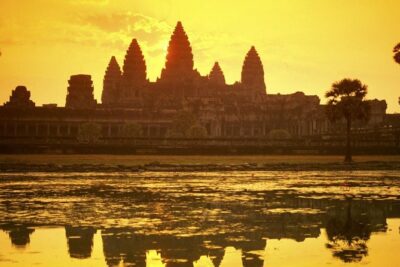
Full-Day Angkor Wat Sunrise Private Tour with Guide from Siem Reap
Read our review →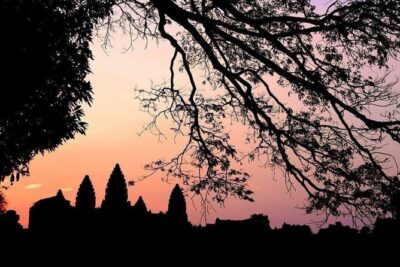
Angkor Wat Sunrise & 3 Main Temples with Breakfast – Small Group
Read our review →This tour also ranks in